

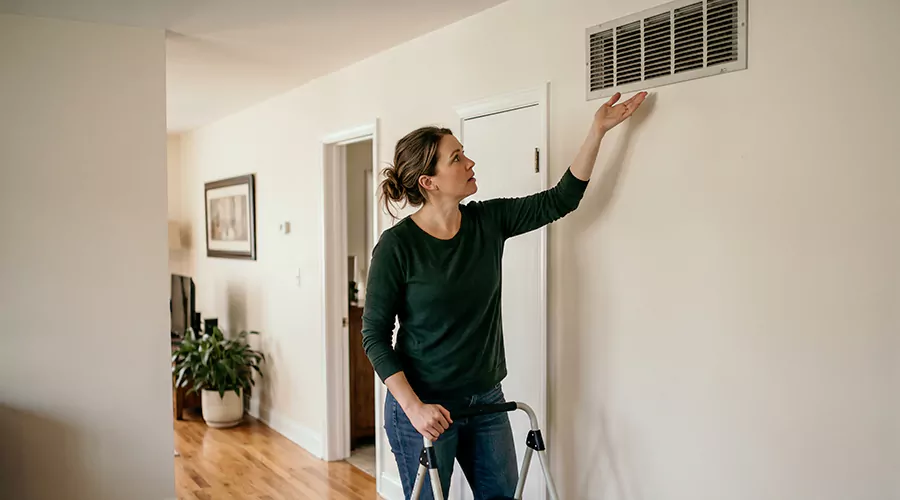
Air vents may blow unevenly because of blocked registers, dirty HVAC filters, leaking or crushed ducts, incorrect balancing damper settings, or improperly sized ductwork. Uneven airflow can also develop when some rooms lack adequate return-air pathways. The best solution is to identify whether the problem affects one vent, several rooms, or the entire HVAC system.
A central heating and cooling system distributes conditioned air through a network of supply ducts. Each branch delivers air to a particular room or area, while return ducts carry indoor air back to the furnace or air handler. Not every register should deliver the same amount of air. Larger rooms and spaces with greater heating or cooling requirements may need higher airflow than smaller rooms. However, noticeable changes in airflow or persistent temperature differences may indicate a problem with duct design, maintenance, or system operation. Air duct repair can address issues such as leaking, damaged, or crushed ductwork that interfere with proper airflow.
Understanding these causes helps homeowners improve comfort without making adjustments that create additional restrictions.
Is Uneven Airflow Normal in a House?
Some variation between registers is normal because rooms have different heating and cooling needs. For example, a large living room may require more supply air than a small bedroom. An HVAC system should be designed to distribute airflow according to calculated room loads rather than deliver equal amounts everywhere. However, a register that produces almost no air while nearby outlets operate normally may indicate a restriction or duct defect. Energy star identifies difficult-to-heat or cool rooms as a common warning sign of poorly performing ductwork.
What Causes Uneven Airflow From HVAC Vents?
| Possible Cause | Common Symptom | Recommended Solution |
|---|---|---|
| Blocked register | Low airflow at one outlet | Remove obstruction |
| Dirty air filter | Reduced airflow across several rooms | Replace filter |
| Closed balancing damper | Weak airflow in a particular branch | Check damper settings |
| Leaking duct | Conditioned air lost before reaching room | Repair and seal |
| Crushed flexible duct | Weak airflow from affected branch | Correct duct restriction |
| Undersized ductwork | Persistent airflow imbalance | Evaluate duct design |
| Restricted return pathway | Bedroom discomfort with door closed | Improve return-air pathway |
| Incorrect register size | Excessive noise or weak distribution | Evaluate register sizing |
| Blower problem | Low airflow throughout system | Arrange equipment service |
| High room cooling load | Warm room despite airflow | Evaluate insulation and windows |
Several causes can occur together. A room with poor insulation and a restrictive branch may remain uncomfortable even after one issue is corrected.
1. Supply Registers Are Blocked
Start by checking the affected registers. Furniture, curtains, rugs, and other household items can interfere with air delivery. Adjustable louvers may also have been closed accidentally. Open the register and move nearby obstructions. The department of energy recommends correctly sized, properly located supply grilles to support effective room airflow. If a register remains weak after being opened, the connected duct may need inspection.
2. The HVAC Filter Is Dirty
A clogged filter increases resistance to airflow through the equipment. This commonly affects the entire system, although rooms receiving marginal airflow may show the problem more noticeably. Inspect the filter and replace it when needed according to the manufacturer's maintenance instructions. Avoid operating the system without its required filter. If the replacement has a different efficiency rating, verify that it is compatible with the blower and filter housing.
3. Ductwork Is Leaking Air
Leaks can occur at branch connections, metal seams, flexible duct collars, and register boots. Energy star reports that approximately 20% to 30% of the air moving through a typical residential duct system can be lost through leaks, holes, and poor connections. A significant supply leak may reduce airflow reaching one or more rooms. An HVAC contractor can inspect the duct network and perform leakage testing when appropriate. Loose joints should be mechanically repaired and sealed with approved HVAC materials.
4. Flexible Ducts Are Crushed or Kinked
Flexible ductwork is frequently installed in attics and crawlspaces. These ducts can become compressed by stored items, poor supports, or sharp bends around framing. Restrictions reduce the effective airflow passage and can make a branch noticeably weaker. The department of energy recommends keeping flexible ducts properly extended, supported, and free from excessive compression. A severely damaged section may need replacement rather than repositioning.
5. Balancing Dampers Are Incorrectly Adjusted
Balancing dampers regulate airflow through individual branches or sections of the distribution network. A partially closed damper may be appropriate when a room requires less airflow. However, an incorrectly positioned damper can create an unintended imbalance. Homeowners should avoid changing several dampers randomly. A qualified technician can measure airflow and adjust dampers according to the system's requirements.
6. Supply Ducts Are the Wrong Size
Ductwork should be designed to carry the airflow required by the connected rooms. An undersized branch creates additional resistance. An inappropriate trunk layout can also cause excessive pressure losses along some airflow paths. ACCA Manual D provides recognized residential duct design methods. The contractor should consider branch length, fittings, blower performance, and available static pressure. Installing a larger register alone will not correct an undersized duct hidden behind it.
7. Return-Air Circulation Is Restricted
Supply air must be able to return to the HVAC equipment. Rooms with closed doors and inadequate return pathways can develop pressure differences that interfere with normal airflow. DOE building america guidance recommends suitable return arrangements, including dedicated ducts, transfer grilles, and jump ducts. If room comfort changes noticeably when the door is open, a return-air problem may be involved. A professional can measure room pressure with the blower operating.
8. Some Rooms Have Higher Heating or Cooling Loads
Uneven temperatures do not always indicate uneven supply airflow. Rooms with large windows, high ceilings, poor insulation, or significant sun exposure may require more cooling than neighboring spaces. Energy star recommends evaluating building-envelope problems, including air leaks and insufficient insulation, when rooms have persistent temperature differences. A room-by-room ACCA Manual J load calculation can help determine whether the airflow matches the space's actual needs.
How to Fix Uneven Airflow From AC Vents?
Step 1. Compare the Affected Rooms
Identify which rooms have weak supply airflow or unusual temperatures. Record whether the problem occurs during heating, cooling, or both.
Step 2. Open the Registers
Check that adjustable supply registers are open. Remove furniture and other obstructions.
Step 3. Inspect the Filter
Replace a dirty filter with a compatible product. Check whether overall airflow improves.
Step 4. Check Room Doors
Observe whether airflow or comfort changes when bedroom doors are opened. A noticeable difference may indicate inadequate return circulation.
Step 5. Inspect Accessible Ducts
Look for crushed flexible branches, damaged insulation, and disconnected fittings. Avoid unsafe attic or crawlspace access.
Step 6. Check for System-Wide Problems
If nearly every register is weak, the issue may involve the blower, filter, evaporator coil, or main return duct. Arrange qualified inspection.
Step 7. Request Airflow Measurements
A contractor can measure register airflow and compare it with room requirements.
Step 8. Adjust Dampers and Repair Ducts
Make balancing adjustments based on the findings. Repair leaks, crushed passages, and other defects before relying on damper changes alone.
Step 9. Recheck Performance
Verify the resulting airflow and room temperatures. The correction should improve the affected rooms without creating unacceptable restrictions elsewhere.
Should Every AC Vent Blow the Same Amount of Air?
No. Proper residential HVAC design distributes air according to each room's load. Two rooms may require different airflow because of size, insulation, windows, or exposure to sunlight. Energy star design guidance recommends room-by-room design airflow to support comfort and efficiency. The goal is not identical airflow at every register but suitable airflow for each space.
Can Closing Other Vents Fix Uneven Airflow?
Randomly closing vents is not recommended. Doing so may increase pressure in the supply ductwork and interfere with blower operation. Proper balancing uses suitable dampers and measurements rather than arbitrary restrictions. A contractor should evaluate the system before making significant airflow changes.
When Should You Call an HVAC Technician?
Professional service is appropriate when simple register and filter checks do not correct the problem. A technician can locate duct restrictions, measure static pressure, and identify airflow imbalances. Significant differences between rooms may require duct repairs, added return pathways, or a redesigned branch.
Conclusion
Uneven airflow can result from blocked registers, dirty filters, damaged ducts, improper balancing, or inadequate return-air pathways. Some differences in register airflow are normal because rooms have different comfort requirements. The correct approach is to evaluate actual room airflow and identify restrictions before making adjustments. Professional balancing and duct repairs can improve comfort when the system is appropriately designed.